
Swarmloom Idle began with a simple image: a colourful garden that does not need protecting, because the player controls the creatures consuming it. I wanted an idle game in which the garden remains visually alive while the swarm works automatically and the important decisions belong to the player.
The current build starts with insects, but I do not think of the project as a game that must remain limited to insects forever. It is a garden-invasion game built around species, growth and adaptation. Worms, caterpillars and other suitable garden creatures can belong to that world later. What matters is the relationship between the living garden and the colony growing across it.
The complete project overview, including the systems already implemented, is available on the Swarmloom Idle project page.
Finding the game inside the idea
The first challenge was deciding what the player should actually do. A garden full of moving creatures can easily become a traditional defence game, but that was not the direction I wanted. In Swarmloom Idle, plants do not fight back. The creatures enter the garden, find plants and feed automatically. The player is responsible for recruitment, upgrades, progression and deciding when to reset a run for a stronger future.
That distinction shaped everything else. The garden needed to be active enough to watch without demanding constant clicking. Each plant has health, disappears when consumed and returns after a delay. Feeding produces Biomass, which becomes the first resource used to expand the swarm and improve its effectiveness.


Building a readable garden
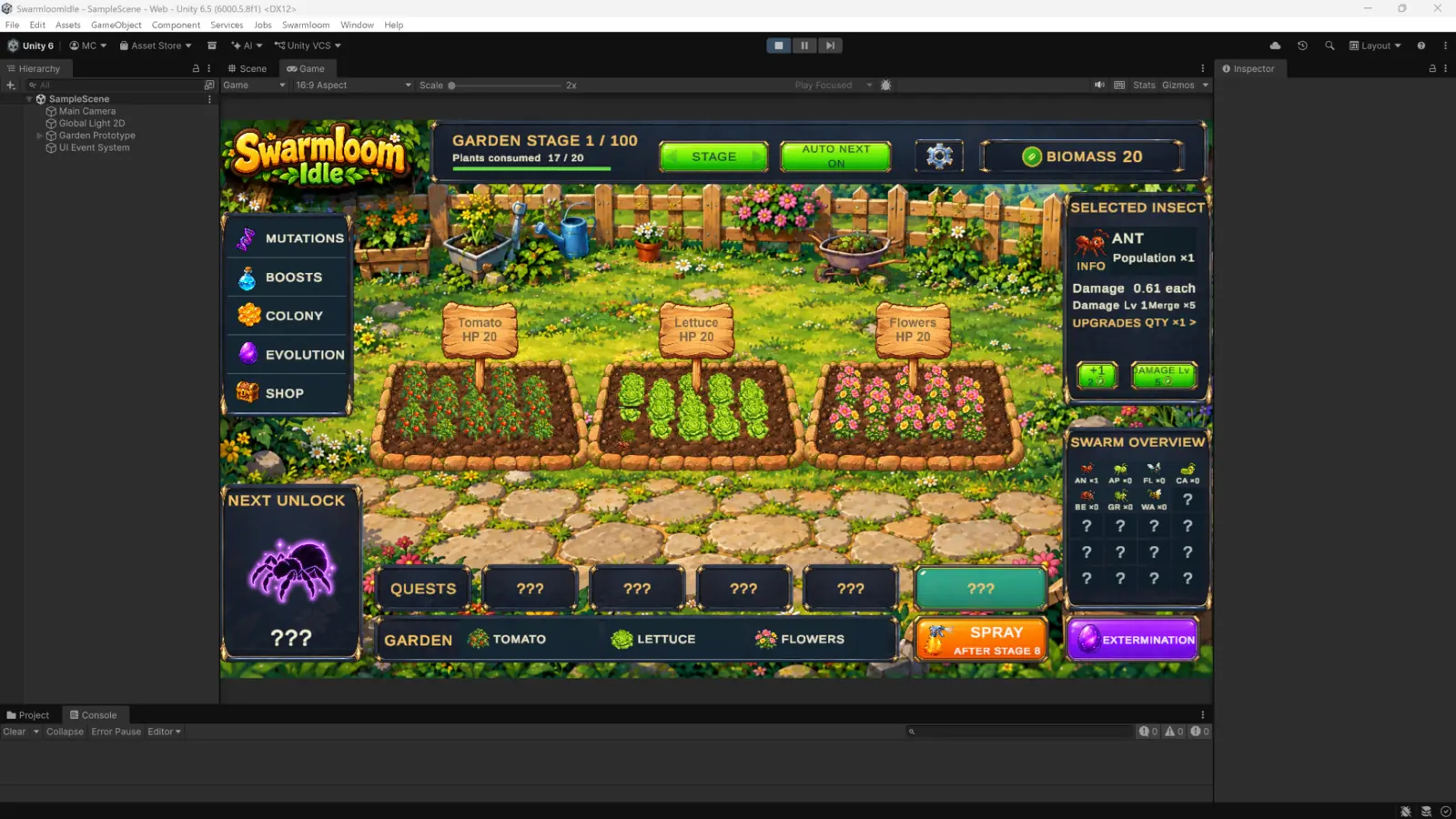
The early Unity screenshots are useful because they show the game as a working project rather than a finished presentation. The editor surrounds the game window, panels are still being tested and the garden is only one part of a much larger development workspace. This is where the project was repeatedly run, stopped, adjusted and run again.
Readability became one of the main problems. A swarm can grow quickly, but a screen full of individual creatures becomes confusing. Matching creatures therefore gather into visible groups without losing their real population. The swarm overview keeps the numbers understandable, while the garden continues to show movement and activity.
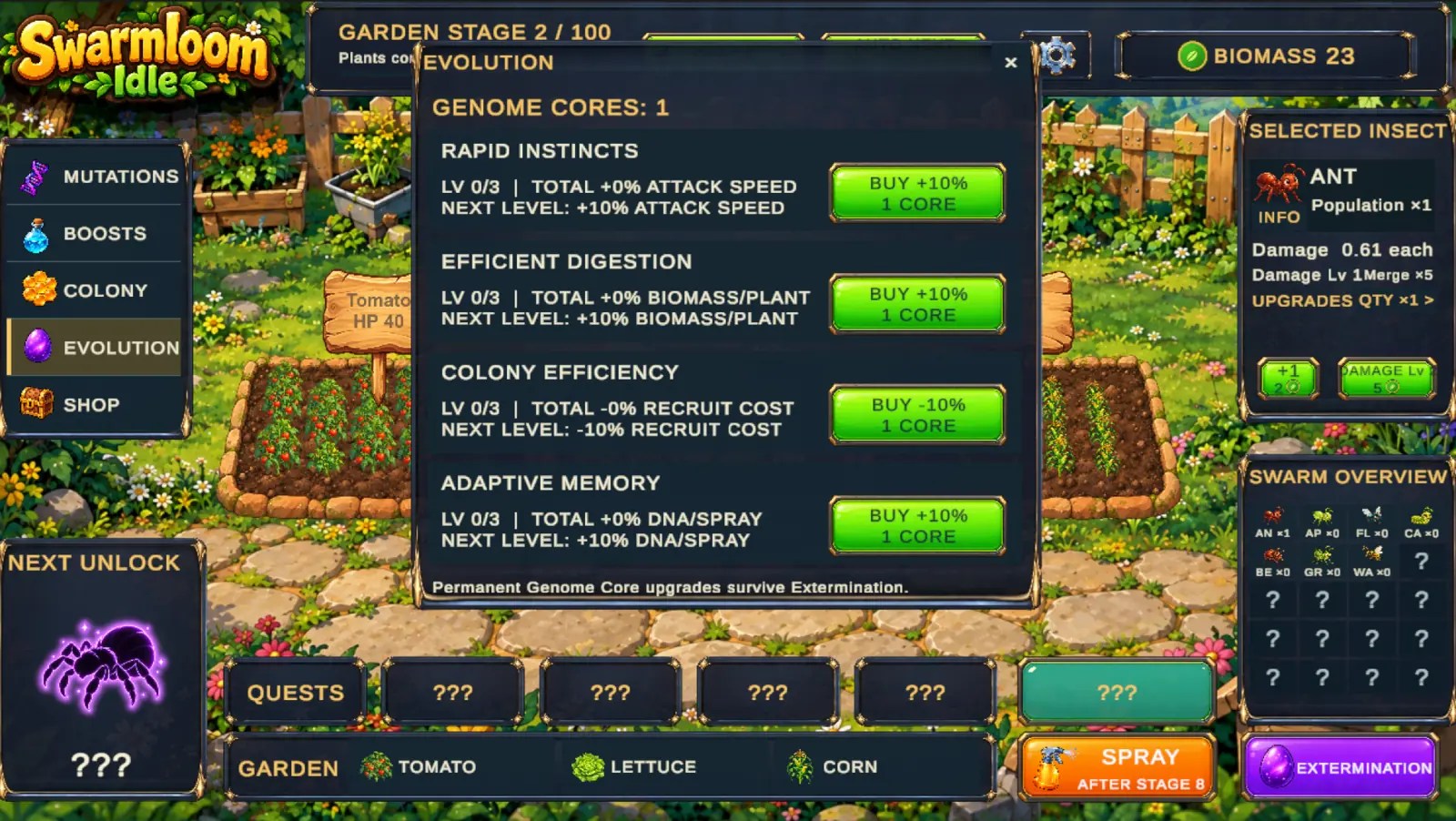
The interface also had to contain several layers without covering the entire garden. Mutations, Boosts, Colony, Evolution and the Shop each needed a distinct purpose. Daily and weekly quests had to be readable without becoming the centre of the game. Settings, save controls and reset explanations had to be available while staying out of the way during ordinary play.
From one ant to a progression system
A new run begins modestly, with an ant and three raised garden beds. From there, the player earns Biomass, recruits more creatures and improves damage. The current version contains eleven insect species, each contributing to the feeling of a growing colony. Some have their own behaviour or supporting effect rather than existing only as a different picture.
Aphids can reproduce during active play. Grasshoppers leap between feeding positions. Wasps poison plants, spiders make webbed plants take more damage and fireflies support nearby attackers with extra speed. These differences gave the roster a reason to exist and created room for future species that behave differently again.
AI-assisted does not mean automatic
Swarmloom Idle was built with AI assistance, but the process was not a single prompt that produced a completed game. I chose the direction, tested the results and decided what stayed. AI tools helped with implementation, debugging, interface revisions, documentation and parts of the visual workflow. Every system still had to be examined inside Unity and judged as part of the whole game.
Some changes were small but important: improving the tutorial, making information easier to find, correcting how plants appeared in the soil and refining the visibility of special plants. Other changes affected the structure of progression itself. The current result was reached through repeated revisions rather than a straight line from idea to release.
These screenshots preserve both sides of that process. The Unity views record the workshop; the later game views show what emerged from it. Swarmloom Idle is now a functioning browser and Android project, but this first chapter is mainly about finding a clear game inside a broad idea—and building enough structure for the garden to keep growing.
Leave a Reply