
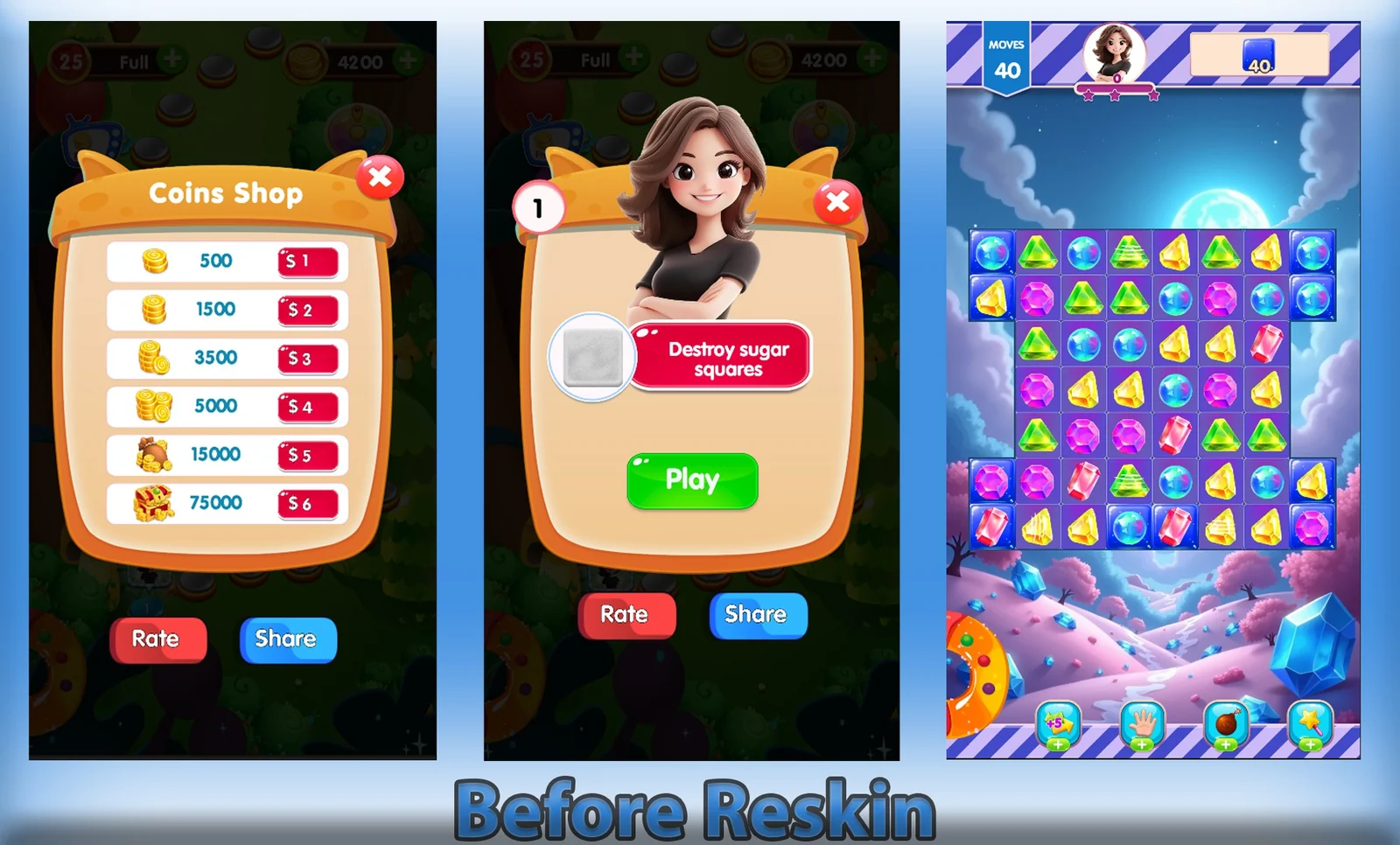
Gems of Luna began with a purchased Unity project, not an empty editor window. I paid $100 through Fiverr for a match-3 build with 100 levels, then paid freelancers to add another 200. That gave me a 300-level foundation. What it did not give me was the illustrated story, expanded puzzle content or visual identity the project has today. Those became the focus of my work with AI and Codex.
I want to document that starting point clearly. The interesting part is not a claim that AI created an entire game from nothing. It is what happened when I took an existing project and began changing its presentation, content and direction.
What the original purchase actually covered
The earlier version already had a playable match-3 structure and a visual skin. The old screenshots show the map, coin shop, level-objective panel and puzzle board. They are useful evidence because they make the starting point visible rather than leaving it as a vague reference to a template.
The $100 was the price of the initial 100-level build. It was not the total cost of everything that followed: the extra 200 levels were separate freelance work, and the later AI-assisted development involved further tools and effort. This is a development account, not a claim that a finished, expanded game cost only $100.

Moving beyond a different name and logo
Once I started rebuilding the project with AI assistance, the scope went beyond changing a title. I replaced or reworked much of the visual presentation: backgrounds, maps, crystals, boosters, buttons, panels, the main screen, logo, icons and promotional banner. The aim was to bring those pieces into a recognisable fantasy direction around Luna.
I also worked on programming and the practical details behind the screenshots. That included readability, contrast, icon consistency, saving progress and boosters, progression on the map, and repairing problematic levels. These changes matter because an attractive screen still needs to communicate clearly and behave properly when someone plays.
Codex and other AI tools helped with code, illustrations and developing the narrative. My role was to direct the project, choose what belonged in it and keep revising the result. The artwork and story are prepared content inside the game, not material generated in real time for each player.
From 300 levels to an expanded puzzle project
The current project contains 2,000 main levels and 100 secret challenges: 2,100 puzzle layouts. It also has Normal, Medium and Hard difficulty modes. Medium opens after completing the final main level in Normal, and Hard follows completion of the final main level in Medium.
Those are two different ways of describing the content. There are 2,100 puzzle layouts and three difficulty progressions; I am not presenting that as 6,300 entirely different puzzle designs. The distinction is important when comparing the earlier build with the expanded project.

Giving progress a story to uncover
The biggest change in identity is not a menu or gemstone. It is Luna’s Story: three illustrated albums connected to progression. Secret challenges reveal parts of an image, and a completed illustration brings a short narrative passage. That gives puzzle progress another purpose beyond reaching the next numbered level.
I am keeping the events and discoveries out of this article. The public development story can explain how the album works without turning into a summary of the plot. Players should meet those moments in the game, in the order they unlock them.
What this rebuild does—and does not—prove
This project shows a concrete use of AI-assisted development: taking an existing foundation and substantially changing what surrounds and extends it. It does not prove that buying a build guarantees a successful game, that AI removes the need for testing, or that a larger level count guarantees returning players. Those are different questions from whether the rebuild exists.
At publication, the Android edition was available on Google Play and I had prepared a separate landscape WebGL adaptation. Update, 7 November 2026. You can now play Gems of Luna in your browser on AIBuiltProjects. Browser progress is saved locally and the Android edition has its own separate save.
Explore Gems of Luna
The permanent project page brings the current game and its development background together. It is the place to start if you want to see what changed and decide whether the game interests you. Visit the Gems of Luna project page for the gameplay overview, screenshots and Android download link.
Built with AI. Directed by human.
Leave a Reply