
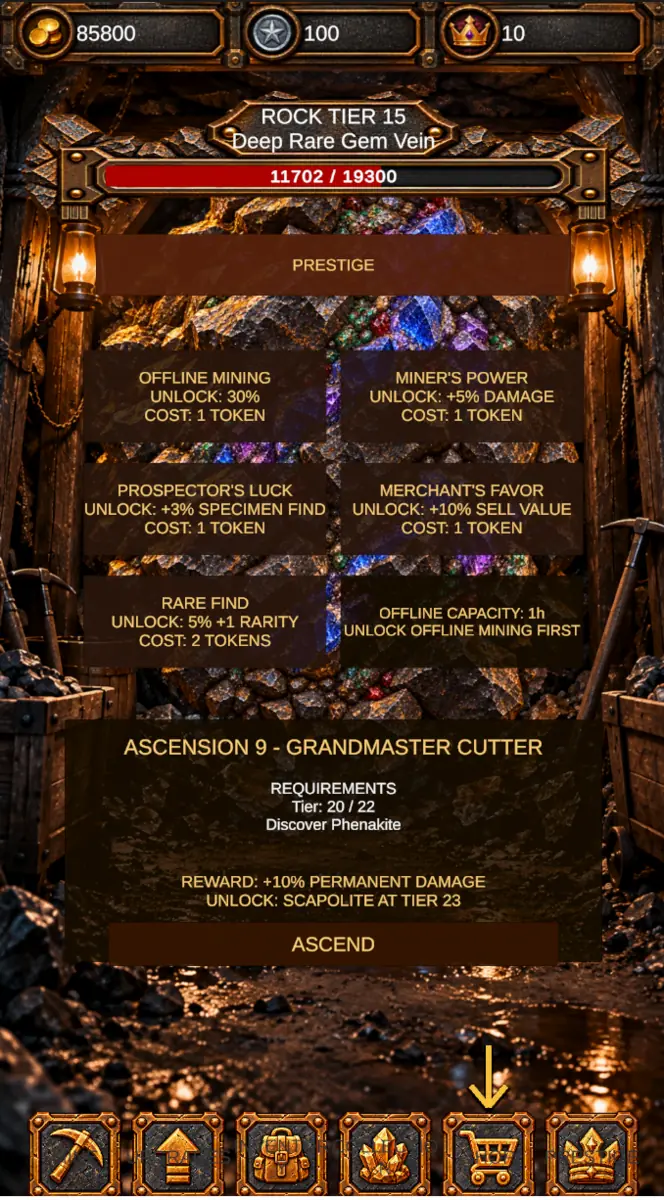
Gem Forge Idle stopped feeling like a collection of separate features when mining, discoveries, specimens, upgrades, quests and prestige began feeding one another. This is how I turned the early prototype into a real progression loop.
Project journal · Building the loop
A game becomes real when its systems begin to feed one another
Once I moved from copying code between ChatGPT and Unity to working with Codex directly inside the project, I could begin making larger, connected changes. The important step was not simply adding more screens. It was deciding why each screen existed and what it gave the player a reason to do next.
This chapter follows the point when Codex entered the Unity project. The prototype already had the beginning of an identity, but it still needed the structure that would make it feel like an idle game rather than a set of experiments.
The difference between features and a loop
At the beginning, getting a rock on the screen and making a number change felt like an achievement. It was an achievement, especially for my first game, but it was not yet a complete reason to keep playing. A proper loop needed one action to create the next decision: mine a rock, earn something useful, become stronger, reach new material and then decide what to do with what I had found.
That sounds simple when written in one sentence. Inside the game, however, every link had to agree with the others. The mining speed had to feel useful. A discovery had to be more than a name in a list. Selling a specimen had to compete with keeping it. Prestige had to make a reset feel like progress instead of punishment.

Mining had to lead somewhere
The mine became the centre of the game. The player can tap to break rocks and see immediate progress, then unlock automatic mining so the process continues without constant input. When eligible progress is waiting after time away, the player can return to offline rewards. I wanted active play and idle progress to support one another rather than make one of them pointless.
Gold earned through mining can improve damage and speed and help open further rock tiers. Each improvement changes the next run through the same basic action. The rock breaks faster, the next target becomes reachable and the player moves closer to materials that have not appeared before. That connection turned the upgrade buttons from isolated numbers into part of the journey.
Discovery gave every run a reason
Breaking a stronger rock is satisfying for a moment, but discovering something new gives that progress a memory. New natural materials register in the discovery collection, so the player can see that the mine has genuinely opened up. The collection became a record of where a run had reached, not merely another menu.
I also wanted individual finds to matter. Rough specimens can differ in qualities such as weight, colour, clarity, quality and rarity. That means two pieces of the same material do not have to feel identical. A find can be sold for Gold, protected in storage or kept for processing later. The interesting part is the decision: immediate progress now, or a specimen that may be more useful or more satisfying to keep?


Short-term progress needed choices
An idle game can easily become a row of buttons that all mean “make the number larger”. I wanted the choice of what to improve to have a visible consequence. More damage changes how hard each hit lands. More speed changes the rhythm of automatic mining. Unlocking further rock tiers changes what the player can encounter. None of these systems needed to be complicated on its own, but together they needed to point in the same direction.
The loop only started to feel complete when mining changed what I could discover, and discoveries changed what I wanted to do next.
Quests gave the player another reason to return
Daily and weekly quests added a second layer of purpose to normal play. Instead of asking the player to abandon the main loop, they can turn familiar actions into shorter goals and reward regular returns. A mining session can therefore move the current run forward while also completing a task with its own reward.
This was important to me because a return mechanic should not feel detached from the game. The quests work best when they encourage the player to engage with systems that already matter, while making a familiar session feel slightly different.

Prestige made starting over meaningful
Eventually, progress in an idle game needs a larger decision. Prestige restarts the current mining run in exchange for Tokens that can be used for permanent upgrades. The player gives up immediate progress but begins the next run with a long-term advantage. Later progression can open Ascension, extending that idea while preserving the achievements that are meant to remain.
The challenge was not simply adding a reset button. The player must understand what is being traded, what survives and why the next run will be different. Prestige gave the earlier systems a destination: mining, upgrades and discoveries could now contribute to a cycle that continued beyond a single climb through the mine.

The loop finally connected
By this stage, the game had a clear chain of reasons to continue:
- Break rocks and earn Gold.
- Improve mining damage and speed.
- Reach further rock tiers and discover new materials.
- Compare specimens and decide whether to keep, sell or process them.
- Complete quests while making normal progress.
- Prestige for Tokens and permanent growth, then begin a new run with a purpose.
No single item in that list defines Gem Forge Idle. The identity comes from the way they reinforce one another. Mining creates discoveries. Discoveries create choices. Choices improve progression. Prestige turns that progression into the foundation for another run.
What Codex changed at this stage
Working directly in the Unity project made this kind of connected development more practical. Codex could inspect the relevant files, follow how one system affected another and make changes across the project without me carrying every piece of code back and forth through the chat. That did not remove my role. I still chose the direction, tested the result and decided what felt right or wrong.
It also did not make every change perfect on the first attempt. A feature could work technically and still need another pass because the explanation was unclear, the balance felt wrong or the screen did not communicate the decision well enough. The difference was that I could now work on the relationships between systems instead of spending most of my time moving code manually.
What this taught me about idle-game design
I began this project without experience building games, so I first thought mainly in terms of features: a mine, a collection, an upgrade, a reset. Building the real loop taught me that a game is not a checklist of parts. The player needs to understand how today’s action changes the next minute, the next return and the next restart.
AI can help me implement systems much faster than I could build them alone, but it cannot make the final judgement about whether the loop is enjoyable or whether a choice is clear. That remains the human part of the project: deciding what the game is trying to become, playing it repeatedly and changing the parts that do not yet earn their place.
Next, the mine became a workshop
Once the mining and progression loop was connected, the rough specimens needed a more interesting future than simply sitting in storage. The next stage brought faceting machines, workers, cabochons, cut gems and diamonds into the project. That is where the mine began to grow into something closer to a gemstone workshop.
Gem Forge Idle is now on Google Play
The game is publicly available. Visit the permanent project page for the complete story, current mechanics, screenshots, release milestones and the official Google Play link.
Leave a Reply