
Once the mining loop was working, I had a new problem: rough stones needed a future. Gem Forge Idle began to change when specimens could leave storage, enter a workshop and return as individual finished pieces.
Project journal · Building the workshop
The mine finally had somewhere to send its best discoveries
In the previous chapter, I described how mining, discoveries, upgrades, quests and prestige began to form a connected loop. That structure made the game playable, but the rough specimens were still asking an important question: what should happen after I decide not to sell one?
The answer became a gemstone workshop. Suitable rough material could be processed into a finished gem or cabochon, while the result retained the identity of the stone it came from. This was the stage when Gem Forge Idle began to feel less like a mine with menus and more like a complete gemstone journey.
A specimen should become more than stock
Rough specimens already had individual properties such as weight, colour, clarity, quality and rarity. I did not want those differences to disappear as soon as a stone entered processing. If the player had taken time to compare two finds and protect the better one, the finished result needed to remember why that decision mattered.
That principle connected the inventory to the workshop. A rough stone was no longer only an item with a sale value. It could become the starting point of another decision: sell it now, keep it safely in the collection or use it to create something more refined.

Processing needed to feel like real progress
The faceting machine turned transformation into a job rather than an instant menu change. Processing has a completion time, and that time is preserved when the game closes normally. The player can start work, leave the game and return later without the job forgetting when it should finish.
That behaviour matters in an idle game. Mining can continue through its own automatic and offline systems, while the workshop creates a second kind of progress in the background. The player is not only waiting for a larger number. A particular stone is on its way to becoming a particular finished piece.
The workshop made time feel attached to an object: I was no longer waiting in general; I was waiting to see what one chosen stone would become.
Workers gave the workshop a face
The worker screen introduced named characters into a project that had previously been dominated by rocks, numbers and inventory cards. Mei appears as a gemstone faceting worker. Even before describing every possible worker mechanic, that change gave the workshop a different personality: it could feel like a place where skilled work happens rather than an anonymous conversion screen.
This is one of the details I enjoy about developing the game. A system can begin as a practical requirement and then suggest a broader identity. The mine is about finding material. The workshop is about judgement, time and craft. Workers help connect those ideas to people inside the game world.

Two ways to finish a stone
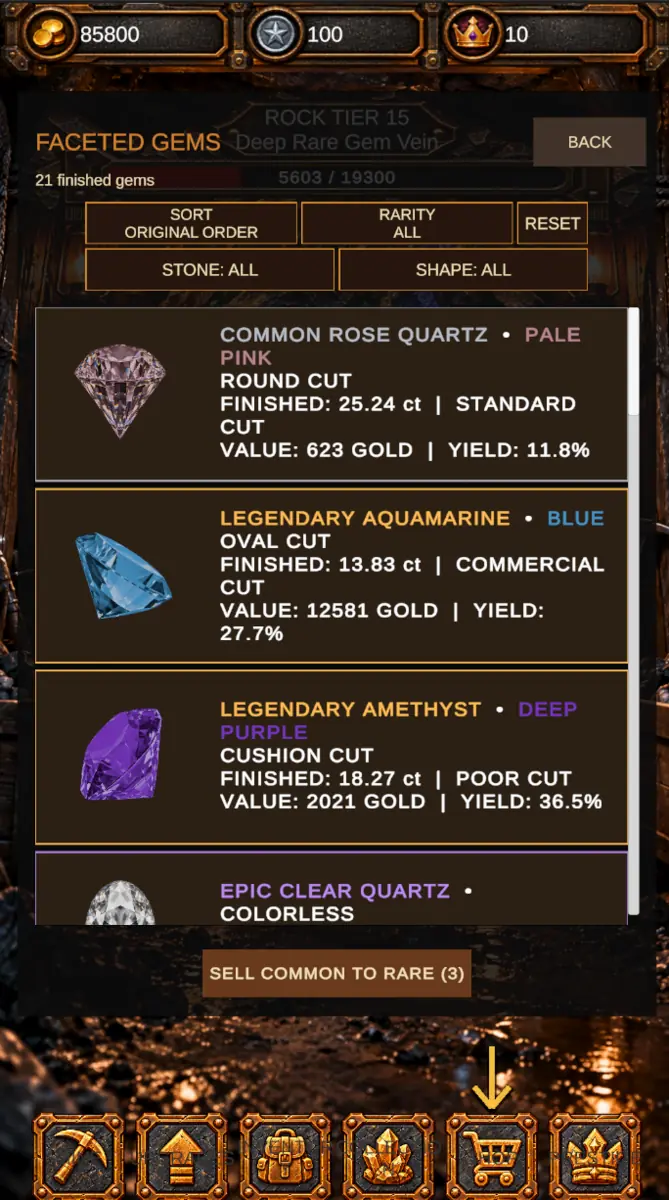
Suitable specimens can become faceted gems or cabochons. That distinction was important because not every finished stone should look as if it followed the same path. Cabochons have their own collection, while faceted gems form another group of finished pieces.
Separating them also made the collection more interesting to browse. The player can move from the natural character of a rough specimen to different styles of finished result, while still recognising the material that began the process.


The finished result still belongs to the original stone
Finished pieces can retain details such as weight, colour, shape, cut quality, yield and value. This means the result is not simply “one quartz” or “one opal”. Two stones from the same material can still tell different stories because the game carries their individual characteristics through the process.
A black opal oval cabochon and a clear quartz pear cut show that idea clearly. One follows the cabochon path and the other the faceted path, but both remain specific pieces with their own recorded result. For a collection game, this is much more satisfying to me than turning every find into an identical resource.


Diamonds needed their own moment
The finished collection also includes diamonds, with different colours and cuts visible in their own inventory view. A fancy-blue cushion-cut diamond is a good example of how far the game had travelled from the first rough shapes on the screen. It is still part of the same basic journey—find, compare, choose and transform—but the result feels distinctly more special.
I did not need the diamond to replace the ordinary discoveries. Quartz, opal and the other materials still matter because they build the collection and teach the player how the workshop works. Diamonds extend that sense of possibility: the next rock might eventually lead to a finished piece worth remembering.


The workshop changed the whole loop
Before processing, the central decision was mostly about how quickly I could mine and what I could afford to improve. The workshop added a second layer of decisions:
- Mine until a promising rough specimen appears.
- Compare its individual properties with other finds.
- Choose whether to sell it, protect it or process it.
- Turn a suitable stone into a faceted gem or cabochon.
- Return after the processing time and inspect the individual result.
- Build a finished collection that remains meaningful beyond one mining run.
That sequence gave the player a reason to care about what came out of the rock, not only how fast the rock broke. The mine creates the opportunity; the workshop decides what the opportunity becomes.
Building connected systems with Codex
This was also the kind of stage that benefited from Codex working directly inside the Unity project. Processing touched more than a single screen. The game had to preserve the specimen, record the job, respect its completion time and produce a finished result with the correct identity. I could describe the behaviour I wanted, let Codex work across the relevant files and then test the complete path myself.
As always, direct project access did not mean that the first result automatically became the final one. I still had to decide what information belonged on screen, whether the result felt rewarding and whether the workshop supported the game I wanted to play. AI made the implementation more practical; it did not replace the judgement behind the system.
What I learned from turning collecting into crafting
A collection becomes more interesting when its objects can have a history. In Gem Forge Idle, a finished stone can carry a line from discovery to rough specimen to processing job to final piece. That history is small, but it gives the player something more personal than a total count.
The workshop also taught me that an idle system feels stronger when different timers and decisions point back to the same goal. Mining produces the material. Storage protects a choice. Processing uses time. The finished collection records the result. Each screen has its own purpose, but all of them describe the same journey.
Gem Forge Idle is now on Google Play
The game is publicly available. Visit the permanent project page for the complete story, current mechanics, screenshots, release milestones and the official Google Play link.
Leave a Reply