
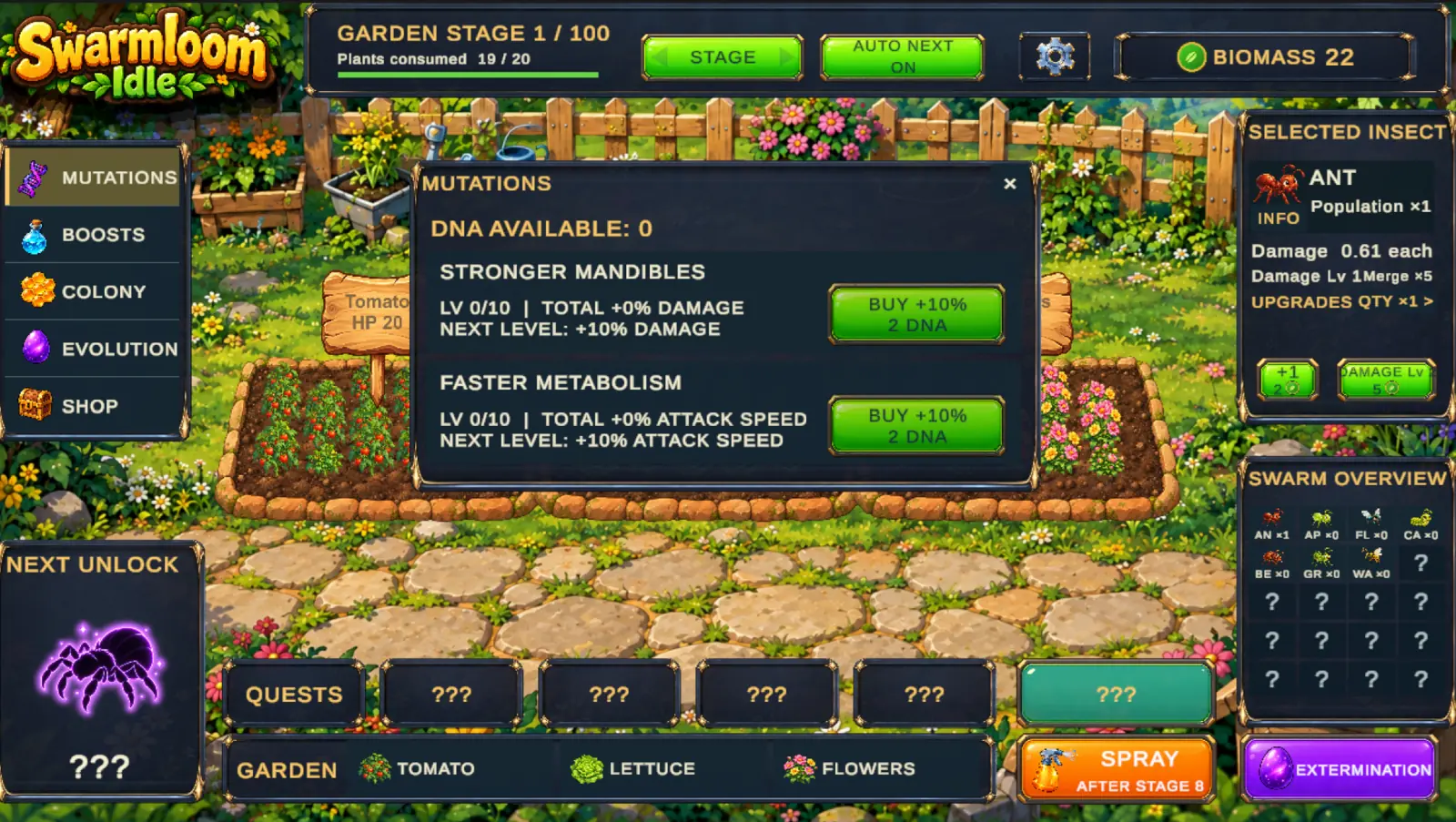
The garden is the most visible part of Swarmloom Idle, but the progression underneath it is what turns the project into an idle game. I did not want a single upgrade list that simply makes every number larger. The game gradually became a collection of connected layers: Biomass, Mutations, Boosts, Colony development, Evolution, Spray and Extermination.
This article looks at how those layers fit together. The broader project, its current platform status and the complete feature record can be found on the Swarmloom Idle project page.
The first loop: consume, earn and recruit
At the beginning of a run, the creatures feed automatically. Plants have health, disappear when fully consumed and return after a delay. Every completed plant contributes Biomass, the basic currency used to recruit more creatures and increase their damage. The player is not asked to click every vegetable; the decisions come from where resources are spent and when progression should move to another layer.
Consuming twenty plants completes a garden stage. A player can advance manually, enable automatic advancement or return to an earlier stage when farming easier plants makes more sense. From Stage 4, a Golden Plant can appear and provide five times the ordinary Biomass reward. It is a simple event, but it gives the garden an occasional moment that deserves attention.


Different upgrade families need different jobs
Mutations spend DNA on direct improvements such as stronger mandibles and faster metabolism. Boosts affect the economy, including Biomass yield and recruitment efficiency. Colony upgrades influence how a run begins and how well the colony continues while the player is away. Separating these functions gives each panel a clearer identity and lets a player decide whether the next improvement should strengthen attack, accelerate income or improve the structure surrounding a run.
Offline Colony is deliberately limited. When a saved game loads, it awards an estimate of Biomass at ten percent of calculated production and within the currently upgraded time cap. It does not pretend that the complete game continued in the background. Creatures are not recruited, stages do not advance and births are not simulated while the game is closed.

Spray: the smaller strategic reset
Spray is the first major decision to stop the current run. It clears ordinary progress and awards DNA, allowing the next garden to begin with stronger Mutations, better production, more efficient recruitment and Colony improvements. The confirmation screen explains both sides of that exchange: what will be lost now and what will remain useful later.

A reset only feels worthwhile when the player understands the bargain. That is why the wording matters. Spray is not a failure screen and it is not a punishment. It is the moment when a completed stretch of play is converted into a new advantage.
Extermination: the larger reset
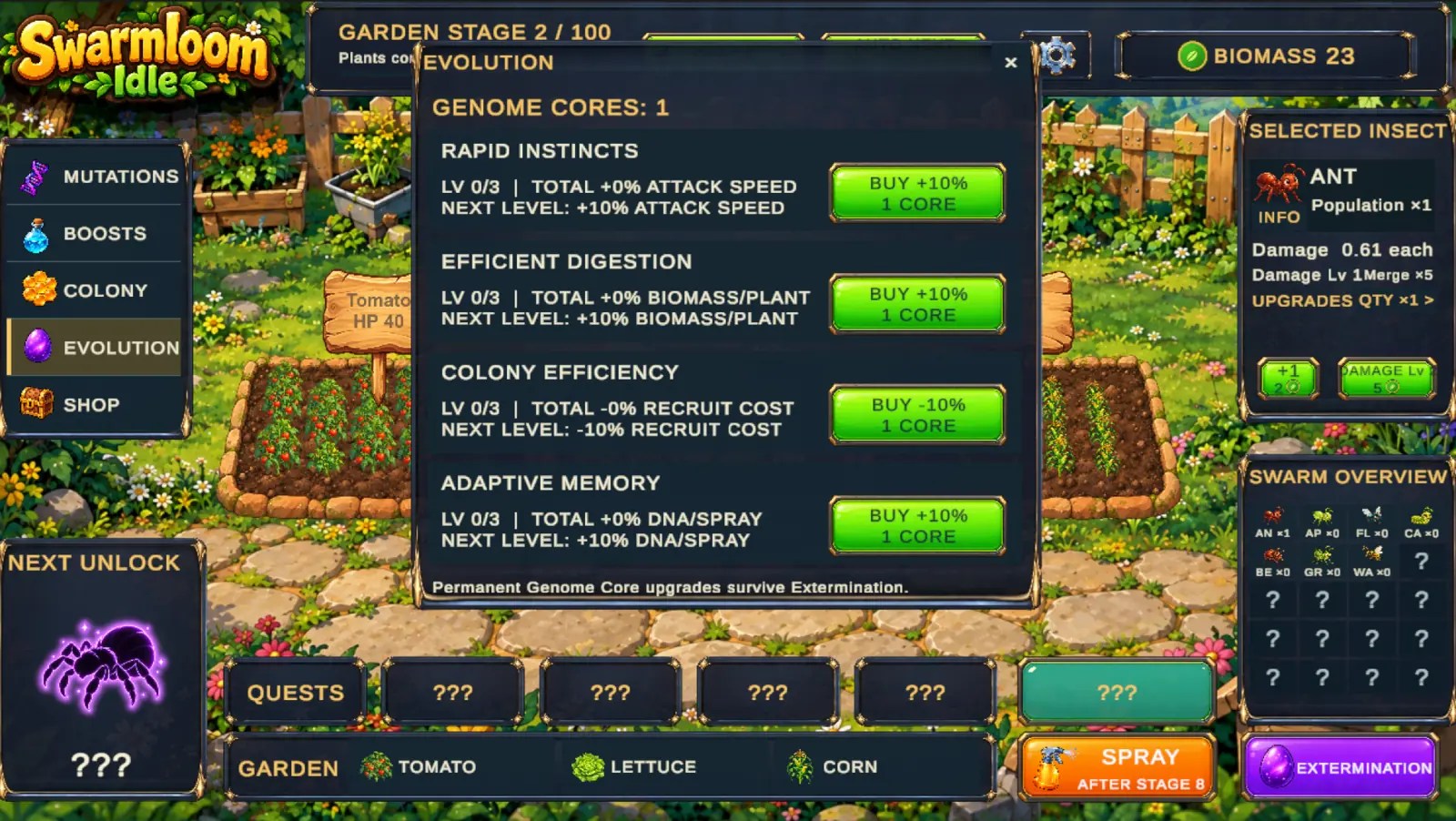
Extermination operates at a higher level. It removes more temporary progress, awards Genome Cores and unlocks another species. Genome Cores are used in Evolution, where permanent upgrades survive this larger reset. The current unlock path includes Wasp, Spider, Mantis, Dragonfly and Firefly, expanding both the visible swarm and the mechanical possibilities of later runs.

This is also where the wider direction of the project becomes useful. The first implemented roster is insect-based, but the garden does not need to remain biologically restricted to insects. Future worms, caterpillars or other suitable creatures can enter as new species when they have a clear place in the progression instead of being added only as decoration.
Progression that can keep growing
The completed structure now has three useful timescales. Biomass supports immediate decisions. DNA and the Colony improve repeated runs. Genome Cores and Evolution reward the largest reset. Quests add short daily and weekly objectives around those systems without replacing them.
The system will still need balancing, especially now that real players can reach it. Costs, rewards and reset timing may change. The important achievement at this stage is that Swarmloom Idle has a progression framework capable of being tuned and expanded instead of relying on one endlessly increasing number.
Leave a Reply