
How long does it take to build a game with AI? My experience has taught me to ask a second question first: which version of the game do you mean? The first playable scene, the first package for testers and the version I feel comfortable putting in front of strangers can arrive at very different times.
I have watched an idea become visible surprisingly quickly. That speed is one of the reasons I kept working with ChatGPT and Codex. But I have also spent time deciding how a game should progress, replaying its opening and adapting it for another platform. Those are all part of building the game, even when the screenshots do not change dramatically.
To build a game with AI, I need a finish line
If my goal is to prove that insects can move towards plants and consume them, the task is fairly contained. If my goal is a complete idle game with several progression systems, clear menus and dependable saves, the task is much larger. Calling both of those “a game” hides the difference that matters most to the schedule.
I now find it easier to think in milestones. First I want a small loop I can actually play. Then I want a build I can give to somebody else. After that come the changes prompted by testing and the work needed for a release. This keeps the excitement of the first working version without expecting it to answer every question about the final experience.
Swarmloom Idle gives me a useful real example
The earliest local milestones for Swarmloom Idle are from 29–30 September 2026. By 1 October I had a local candidate prepared for public testing. That was a package milestone, not a claim that it was already published everywhere. The garden and its first insect had given me something concrete to play and develop.
By the end of October, the project had grown into a game with 20 insect species and several layers of progression. I confirmed the Kongregate 1.0.10 publication on 31 October. Roughly a month separated those early local milestones from that release, but the time contained much more than waiting for AI to finish a single instruction.
The first loop was only the beginning
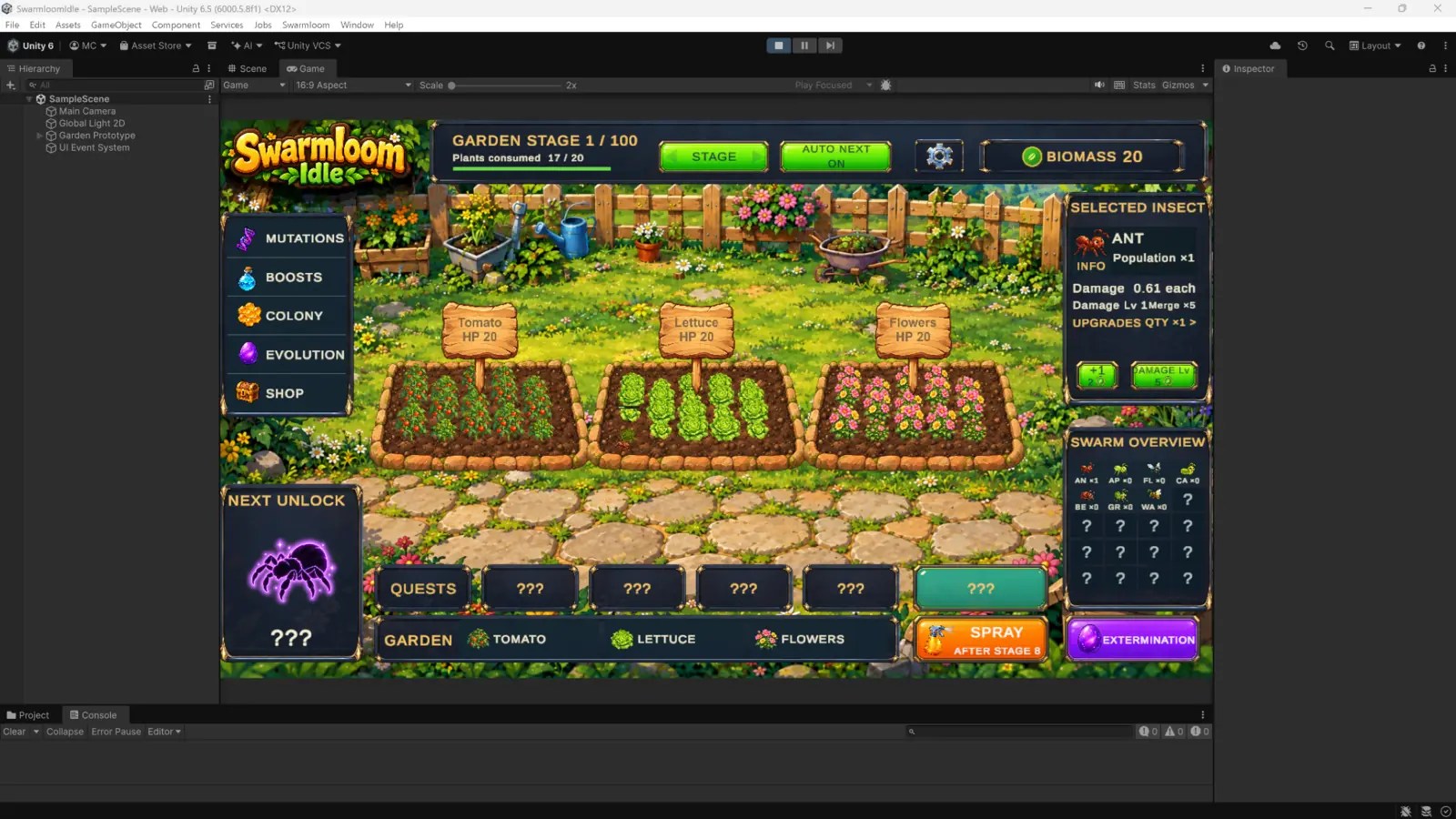
In Swarmloom, the basic idea is simple: the colony consumes plants and I decide how to invest the resources. Developing that idea meant asking what should happen after the first few upgrades. New species needed a purpose. Resets needed to give players a reason to return stronger. The interface needed to explain those choices without burying the garden under permanent panels.
I could get help with the code behind those systems, but I still had to live with the decisions as a player. A feature that sounded good in a conversation might need a clearer explanation or a different place in the progression. This is why counting generated scripts would tell me very little about how close the game was to feeling complete.
A smaller app can move at a very different pace
Chaos Booth gave me another useful comparison: I reached a working app in about two days. It is a photo-challenge app, not an idle game, so I would not use that result to promise a two-day game launch. What it shows is how much the size and shape of an idea can change the time needed to reach a first usable version.
With a contained flow, I can make decisions around a smaller set of screens and actions. With an idle game, I also need to think about what happens over longer play sessions. Progression, collections, repeated rewards and returning after time away create different questions. AI helps with both kinds of project, but it does not make their workloads identical.

The platform changes what “finished” includes
A game running on my development machine does not settle every question about its Android version. A browser version brings another set of checks. I have to think about the screen shape, readable buttons, loading and how progress behaves when somebody closes the page. Adding another platform can be worthwhile, but it is still additional work.
The clearest example is saving. Remembering progress in one browser is useful, but moving that progress between a phone and the web is a separate feature with its own tests. I do not count those as the same milestone. Keeping the boundaries clear lets me release something useful without describing work that is still being tested as already finished.
What I would do on a first AI-built game
I would start with a loop that can be explained in a sentence and put it in somebody else’s hands early. That does not mean making the whole game tiny forever. It means finding out whether the central action is worth developing before surrounding it with lots of upgrades, menus and content. Swarmloom’s colony gave me that starting point.
I would also keep the first release separate from the entire wish list. Gem Forge Idle has continued to develop through its mining, collecting and faceting systems; I did not need every future workshop idea to exist before I could learn from players. You can see that ongoing project in Gem Forge Idle on Google Play.
My answer is milestones, not an instant-game promise
For Swarmloom, my real example is a playable foundation around the turn of September and October, followed by roughly a month of development to the end-of-October release. A smaller prototype can appear sooner, and the work can continue long afterwards. That is a more useful expectation than treating the first impressive screen as a finished business.
The part I like most is that AI makes starting feel possible. I can try ideas, see them on screen and keep the ones that deserve more attention. The time I save at the beginning gives me more room to play, judge and improve the result. That is the advantage I would plan around if I were starting again.
Built with AI. Directed by human.
Leave a Reply