
Can you publish a game made with ChatGPT on Google Play? Yes. I have taken an AI-assisted Unity game through that process, and Gem Forge Idle is available on Google Play. The interesting part is what happens between the first working idea and the moment somebody else can install it.
When I started, getting something to run felt like the big achievement. A rock could take damage, resources could increase, and an upgrade could make the numbers move faster. That was exciting. But a working scene in Unity and a game ready for someone else’s phone are two different milestones. AI helped me move between them; it did not make them the same thing.
What it means to publish a game made with ChatGPT
For me, “made with ChatGPT” describes the development process. I used AI to help turn ideas into code, work through problems and develop the presentation. I still chose the direction, played the builds and decided what needed to change. The finished game was a Unity project that I could build and test, not a conversation that somebody had to open inside ChatGPT.
That distinction matters if you are wondering whether this is practical. I did not need to persuade players to understand my prompts. I needed to give them a game that opened, explained itself and remembered their progress. A player tapping a rock in Gem Forge Idle is interested in the next discovery, not the tools I used while building the mine.

The game needed a reason to keep playing
The idea behind Gem Forge Idle came from something I already enjoyed: gemstones and faceting. Mining was the beginning, but I wanted rough discoveries to lead somewhere. Players could collect specimens, decide what to keep and eventually turn suitable stones into finished gems. That gave me more direction than simply asking AI to make an idle game.
It also gave me decisions that no store checklist could answer. Should I sell this discovery now or keep it? Is the next upgrade worth waiting for? Does a reset give enough back to feel worthwhile? I could ask AI for implementations and alternatives, but I had to play the result. Publishing was the destination; the experience inside the game was what made the journey worth doing.
Testing came before the public release
I tested builds and used Google Play’s testing process before the public release. I wanted to see the game outside the environment where I had been developing it. Installing, closing, reopening and returning to a save are ordinary player actions, but they become very important when you are the person responsible for the game.
For newer personal developer accounts, Google currently requires at least 12 testers to remain opted into a closed test continuously for 14 days before an application for production access. That is an eligibility requirement, not a promise of automatic approval. I keep the official Google Play testing guidance beside the practical work rather than treating a completed timer as the whole job.
The store listing was part of the product
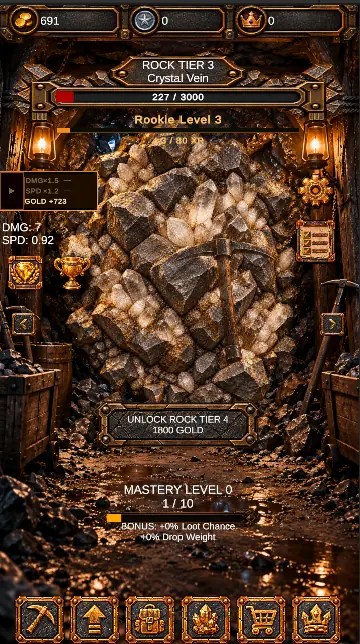
I also had to present the game to somebody who knew nothing about it. That meant choosing screenshots, explaining the gameplay and making the visual identity consistent. The description had to match what a player could actually do. A picture of a faceting machine is useful when faceting is part of the experience; it should not imply a completely different game.
This was where having a clear theme helped. Rocks, rough stones and finished gems belonged together. Instead of making a long list of AI features, I could show the player’s journey through the mine. The same approach helped me think about the icon and screenshots: what would make a stranger understand the game before pressing Install?
I remained responsible for what I shipped
Using AI did not give me a separate route around the ordinary responsibilities of releasing an app. I still needed to review the build, describe its data handling accurately and understand the services I had included. Optional ads, purchases or analytics are not details I can ignore just because an assistant helped with the code.
I find it more useful to think in terms of the finished application than the impressive development shortcut. Can somebody read the interface on a phone? Does the next action make sense? Is the advertised feature present? Those questions kept the project grounded. They also gave me something concrete to improve when I returned to development after the initial release.
Publishing is a real milestone, not the end of the experiment
Seeing the game on Google Play was satisfying because it moved the experiment out of my own workspace. Somebody else could install it and form an opinion. That is different from proving that a game will attract a large audience or pay for all the work behind it. I had reached the point where those questions could be tested with an actual product.
So my answer is yes: I can publish a game made with ChatGPT’s assistance, and I have done it. What made that possible was combining AI help with a clear idea, repeated playtesting and the work of preparing a real release. If you are considering the same route, start with something small enough to finish and meaningful enough that you want to keep improving it after the first download.
Built with AI. Directed by human.
Leave a Reply