
Should I buy a game template or build from scratch with AI? I have approached projects from both directions, and the most useful answer comes from comparing what I actually started with. Gems of Luna began with a purchased Unity build. Swarmloom Idle grew around an idea I wanted to develop: putting the player in charge of the insects consuming a garden.
Neither route removed the work of making the game feel like mine. An existing project gave me something playable sooner. A more individual starting point gave me room to shape the central loop from the beginning. The choice was less about finding a universally correct method and more about understanding which decisions I was buying and which ones I wanted to make myself.
Game template or build from scratch with AI: my purchased starting point
For Gems of Luna, I paid $100 through Fiverr for a match-3 build containing 100 levels. I then paid freelancers to add another 200. That gave me a 300-level foundation with a working puzzle structure and existing screens. It was a practical way to have something I could open, play and assess.
What I bought was a starting point. The extra levels and the later AI-assisted development came afterwards. Having a complete project to explore helped me see which parts I wanted to keep and which parts I wanted to change. I could assess an existing structure instead of making every early decision in an empty Unity project, and that made the first steps feel much more tangible.

Having a foundation did not settle the identity
The project already had a match-3 board, map and interface, but I wanted a more coherent direction around Luna. With AI assistance, I worked on backgrounds, maps, gemstones, boosters, buttons, panels and the wider presentation. The aim was to make the different parts belong to the same world rather than simply replace the name above an otherwise unchanged game.
The work also extended beyond artwork. I dealt with readability, saving, progression and problematic levels. A ready-made foundation can save the time needed to build its original systems, but it also gives me systems I need to understand before changing them. That is where the real comparison begins: am I extending the existing design, or spending most of my effort trying to turn it into something else?
The current game shows why I kept developing it
Gems of Luna developed into a project with 2,000 main levels and 100 secret challenges, alongside its difficulty progression and illustrated albums. The story gives the puzzles another purpose: uncovering images and discovering the next part of Luna’s journey. That identity came from the direction I chose after acquiring the original build.
I like this example because the difference is visible. I can put the earlier screens beside the current game and see what changed. I do not need to describe the result as a one-prompt creation or pretend the original foundation never existed. The interesting part is what I was able to do with that foundation once I had tools that helped me keep developing it.

Watch the Gems of Luna trailer
The trailer brings the current story and gameplay presentation together. It is a more immediate way to meet the finished direction than reading a list of all the individual assets I changed. If the atmosphere interests you, the next step is to try the puzzles themselves.
You can play Gems of Luna on Google Play. The earlier screenshots above show the starting point; the trailer and current screens show where I took it. That contrast is the reason I find this project useful when somebody asks whether an existing build can still become a personal creative project.
Swarmloom started with a different question
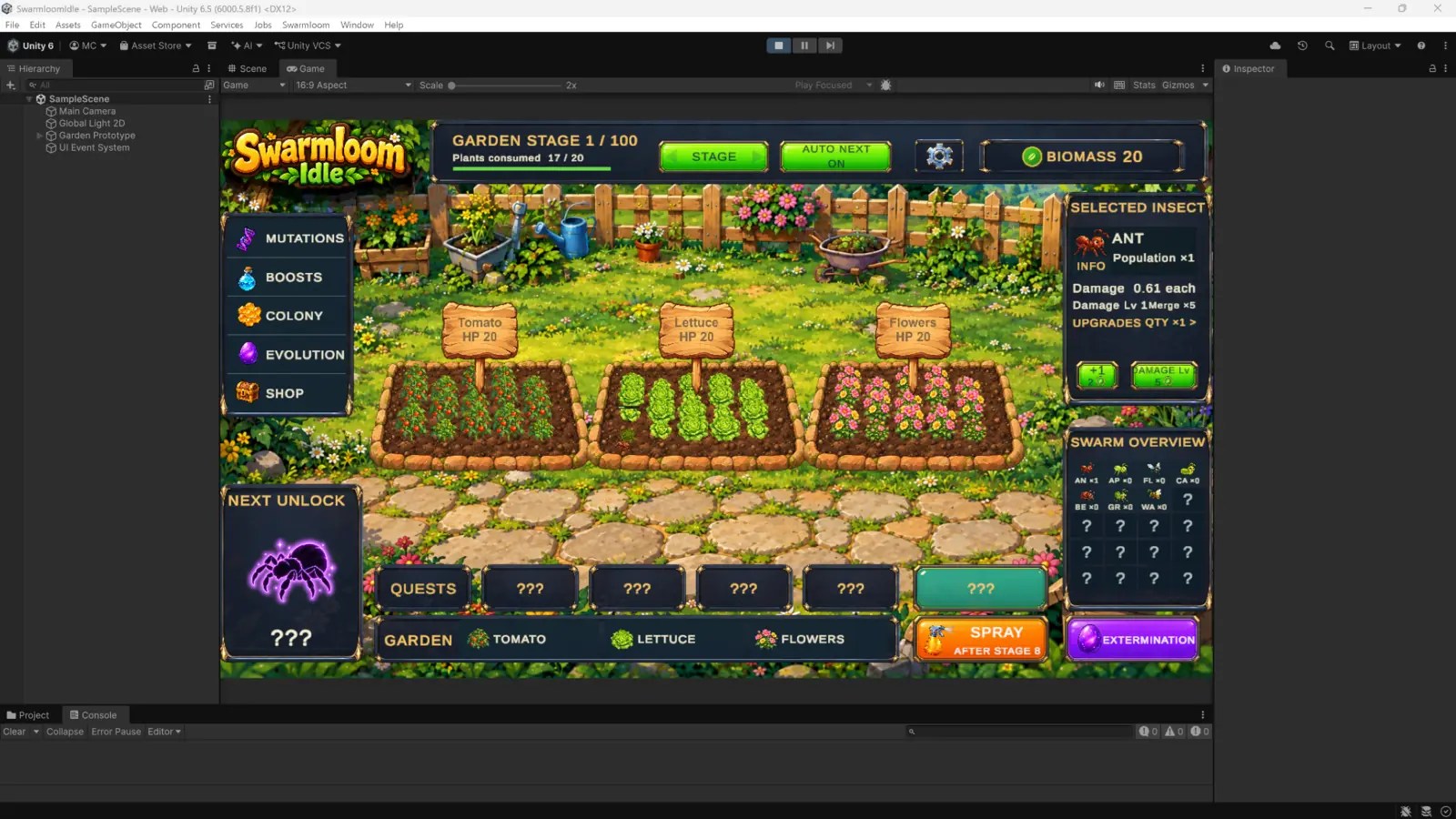
With Swarmloom Idle, the central idea came first: what if I developed the colony instead of protecting the plants? That premise influenced the resource loop, species and progression. I was not starting by choosing which existing puzzle interface to preserve. I was trying to make a particular kind of garden invasion enjoyable.
Working this way gave me freedom, but it also meant more choices were still open. I needed to decide how the colony grew, what the player would manage and how the next system should arrive. AI helped me explore those decisions through working versions. The freedom was valuable because I cared about the idea, not because starting from less automatically made the work easier.
What I would look at before choosing
I would first ask whether an existing project already supports the experience I want. If I mostly want to change presentation and extend a familiar loop, a sound foundation could be useful. If the appeal lies in a different central mechanic, I would be more cautious about buying a project that I would immediately need to fight against.
I would also look beyond the headline price. I want to know what is included, what I am allowed to use, whether I receive usable source files and whether the project can be maintained in my development environment. Those are practical questions I would settle before a purchase. A cheap starting point is only useful if I can actually take it forward.
My choice would follow the idea, not the shortcut
I would use either route again for the right project. Gems of Luna shows what I can do with an existing playable foundation. Swarmloom shows why I sometimes want to shape the loop around my own premise. AI assistance is useful in both cases because it gives me more ways to turn decisions into something I can play and judge.
The question I would keep coming back to is simple: which starting point leaves me doing the work I genuinely want to do? If the foundation supports the game I have in mind, I can build on it. If the game’s main appeal needs a different foundation, I would rather begin smaller and develop that idea deliberately.
Built with AI. Directed by human.
Leave a Reply